Processing mail
Order and prepare an answer.
AI that helps you think and act. Let it prepare and carry out defined tasks so your team has more time for work that needs their attention.
The task and available context.
A proposal with clear limits.
Only allowed actions; review where necessary.
Results and exceptions visible.
More capacity for your team, no unlimited autonomy or promise to replace employees.
Order and prepare an answer.
Collecting relevant questions and follow-up steps.
Bring together available context and conversation points.
Summarize information within authorized sources.
Only with appropriate linkage and explicit mandate.
Bring together information for assessment and follow-up.





Examples, no warranty on any available link or partner status. APIs, rights, consent and scope determine what is possible.
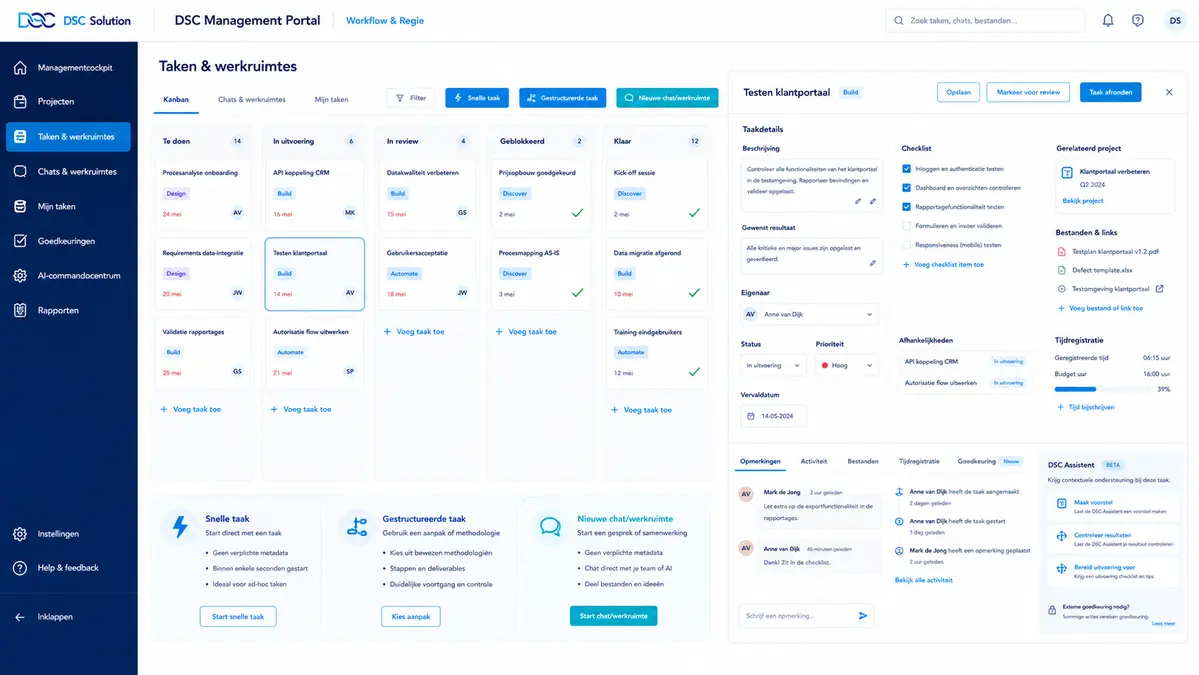
 AI Management PortalInteractive demo
What context do you need to do this?
A task sometimes requires information from multiple existing tools. System boundaries and access rights remain valid.
Just ask for the data that this task needs.
Determine which source is read and where a proposal is prepared.
Valide the write capacity and permission per system.
May I prepare this proposal? First, look at the steps and boundaries.
Status: proposal ready
Example interaction · no live business data or external execution.Only access to what is necessary for the task.
The competent person shall assess sensitive actions.
Make proposals, decisions and implementation traceable.
Prefix exceptions, stops and recovery options.
AI agents are software-based assistants that can analyse, prepare, carry out and monitor tasks within predefined rules. They use available business context and connected systems to take steps within the permissions, boundaries and approvals set by your organisation.
That depends on your processes and connected systems. Examples include handling emails, following up leads, updating CRM data, preparing meetings, analysing documents, generating reports, gathering information and coordinating workflows. We automate only tasks for which access and governance are in place.
No. We aim to keep existing software where it works well. Connectors can link ERP, Marketing Automation & CRM, email, documents and other systems to the central AI layer.
Each agent operates within explicit permissions. Your organisation decides which data and systems it may access, which actions it may take independently and which require prior human approval. Important actions can be logged and reviewed.
Yes, for tasks authorised in advance. Routine, low-risk actions may be automated. Approval steps can be required for sensitive, significant or hard-to-reverse actions.
AI can make mistakes. DSC therefore combines automation with permissions, approvals, logging and human review where needed. For critical processes, we deliberately limit autonomy and provide fallback or recovery mechanisms where appropriate.
That depends on process complexity, data, connectors and the desired level of autonomy. A clearly defined use case may start relatively quickly; more complex workflows require more analysis, integration and testing. DSC therefore works in phases.
Yes. That is often a sensible approach. We can start with one process or repetitive task, evaluate how it works and then expand in a controlled way.
No. The tools shown are examples. Which systems can be connected depends on available APIs, connectors, technical feasibility and access rights.
We define in advance which outcome the agent should improve: for example, less manual work, faster processing, better follow-up, fewer errors or more time for higher-value work. The relevant KPIs vary by use case and are set beforehand where possible.
Yes. An organisation does not need a large IT team to start with a limited AI agent use case. The solution is tailored to its size, processes, risks and maturity.
Traditional automation usually follows predefined rules. An AI agent can also interpret information, use context, prepare decisions and combine steps within agreed boundaries. DSC uses both: automation where predictability matters, and AI where context and flexibility add value.
The aim is not simply to replace people, but to take on routine, time-consuming work so employees have more time for customers, decisions, creative work and other tasks where human expertise adds most value. Your organisation decides which tasks AI performs and where human involvement remains necessary.
Start with defined repetitive work, such as e-mail preparation, documents, meetings, reporting or CRM follow-up. Access, feasibility and risk will be assessed first.
Not unlimited. The organization determines mandates and what actions require human approval. Sensitive actions get an explicit decision-making moment.
Yes. Choose a defined usecase, test the operation and exceptions, and expand based on demonstrable value.
Not automatic. DSC investigates appropriate links; APIs, rights, data and scope determine what is feasible.
Your goals, existing systems and team are the starting point. Together we determine a feasible next step.