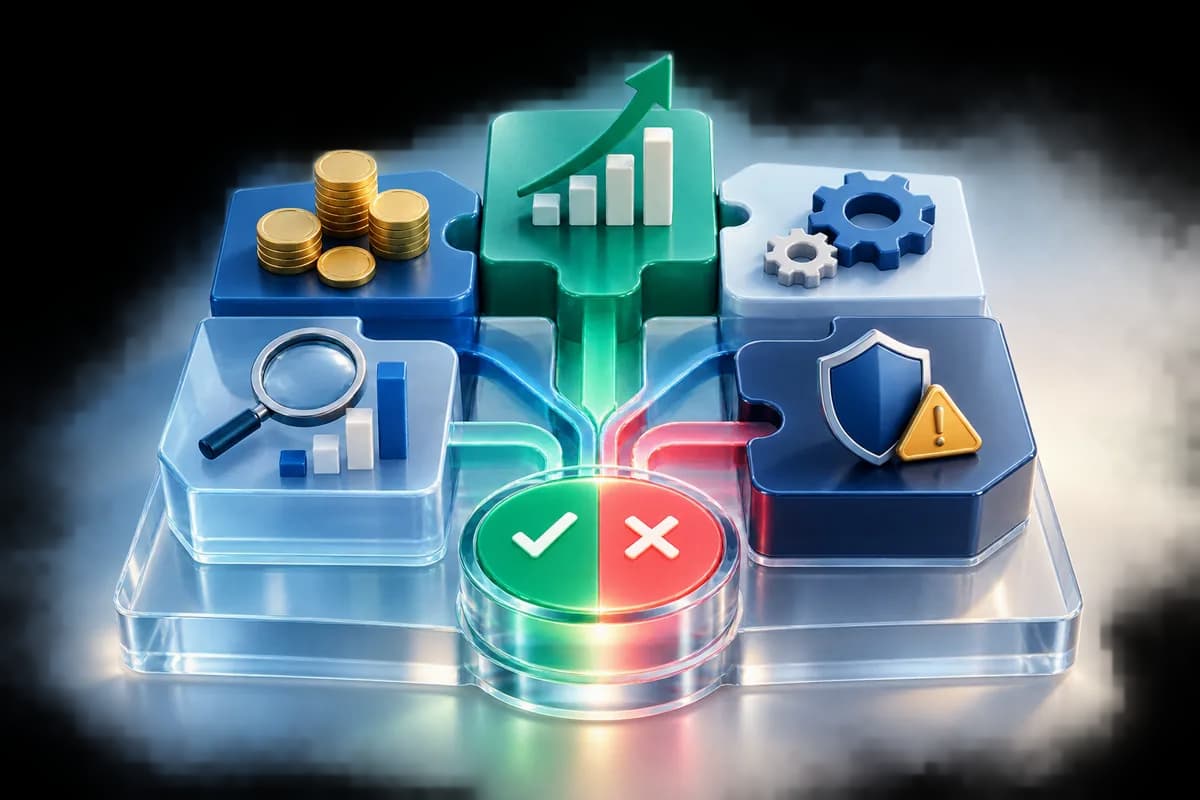

Determine goal
Define the problem and the desired outcome.
Group opportunities
Bundle ideas around processes and value streams.
Three-dimensional testing
Assess value, feasibility and manageability.
Scheduling dependencies
Put data, process choices and integrations in the correct order.
Make decisions in phases
Work with pilots, validation criteria and explicit go/no-gos.
Why an idea list is not yet an AI roadmap
Workshops often generate dozens of ideas: summarizing documents, preparing quotations, classifying customer questions or supporting planning. That is useful input, but no implementation plan yet. Ideas differ in expected value, required data, process maturity, risk and technical dependencies.
Without a decision framework, visible or technically attractive ideas are easily given priority. The organization then starts multiple experiments, while ownership, data quality or integrations have not yet been arranged. A roadmap makes this connection visible and prevents a pilot from being confused with an operational system.
Practical decision framework: value, feasibility and manageability
Business value goes beyond potential time savings. Ask which outcome improves, who notices that improvement and how you measure it. Consider shorter lead times, less repair work, higher quality, extra capacity or better controlled risk.
Feasibility is not just about technology. Is the process sufficiently stable? Is the necessary data available and usable? Can existing systems be connected safely? Is there time for the employees who know the process? Manageability includes privacy, security, explainability, exceptions and the ability to intervene.
- Which concrete business outcome needs to change?
- What baseline measurement and data are available?
- Which process steps, systems and owners are dependent?
- Which errors are acceptable and which are not?
- Where is human control or formal approval needed?
Also prioritize the order of learning
The best first use case is not always the one with the greatest theoretical payoff. A smaller initiative can be more valuable if it quickly provides evidence about data, adoption, or integration while providing a necessary building block for later applications.
Therefore work in phases. An exploration confirms the problem, scope and baseline measurement. A defined test tests the critical assumptions. Only then will a controlled implementation follow. You define acceptance criteria, decision makers and stopping conditions in advance for each phase.
Illustrative example: document processing
Suppose a fictitious B2B service provider wants to automatically extract information from incoming documents. The assumption is that employees lose a lot of time retyping and checking. For the roadmap, it is first measured how many documents are received, how much variation there is and where errors are occurring today.
A first trial uses one document type and has each extraction confirmed by an employee. Only when completeness, error handling and lead time meet the agreed conditions will a link with the core system be considered. The test therefore not only proves whether the model works, but also whether the process can be set up in a manageable manner.
What does this mean for your organization?
A roadmap is useful when ideas pile up, pilots arise independently or teams have different priorities. Start with a single, shared view of business goals, processes, opportunities, dependencies, and owners.
Do not start building yet if the problem is unclear, the baseline measurement is missing or crucial data is not legally and reliably available. The realistic first step is a short prioritization session in which you select a maximum of a few promising use cases for further validation.
Sources for this section: European Union · Data Protection Authority
Frequently asked questions
How many use cases should be in an initial roadmap?
There is no fixed number. Limit the active portfolio to what your organization can validate, guide and manage at the same time. A larger longlist can continue to exist as a backlog of ideas.
Should every use case have a financial return?
No. Quality, risk reduction, compliance and employee or customer experience can also be valuable, as long as the desired change and measurement method are clear.
How often do you revise the roadmap?
At least at every validation or decision point and whenever an important assumption, dependency or legal context changes.
When is a pilot successful?
When the previously agreed assumptions have been sufficiently tested to make the next decision. This could also mean that you consciously do not continue to build.
Sources
The sources below support the indicated factual and regulatory passages. The practical decision frameworks are professional recommendations from DSC Solution.
- NIST — Artificial Intelligence Risk Management Framework (AI RMF 1.0)January 26, 2023Gebruikt voor: risk management, governance and the cyclical measurement and management of AI risks.
- NIST — AI RMF Playbookaccessed August 29, 2026Gebruikt voor: practical actions around Govern, Map, Measure and Manage.
- European Union — Regulation (EU) 2024/1689 — AI ActJune 13, 2024Gebruikt voor: risk-based obligations, documentation, monitoring and AI literacy.
- Data Protection Authority — Information brochure about artificial intelligence systems and the GDPRDecember 2024Gebruikt voor: Belgian points of interest for AI and personal data.