Marketing Automation & CRM
Bring together commercial context, campaigns and follow-up.
More about Marketing Automation & CRM
Your ERP, CRM, email, documents and meetings connected through one AI supported management and delivery environment. More control. Faster execution. AI kept within clear boundaries.
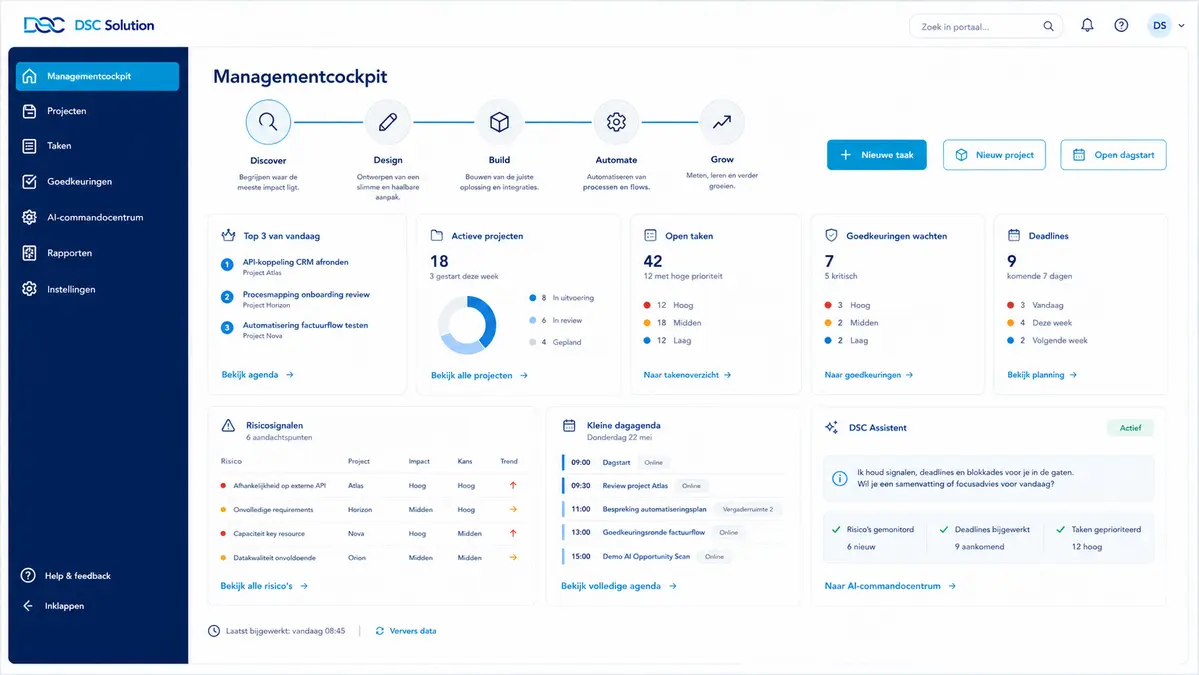
Context, AI Assistant, workflows, reels, approvals and logging.
Your central management and implementation layerDon't replace everything, but let everything work together smarter and optimize.





Examples, no warranty on any available link or partner status. APIs, rights, consent and scope determine what is possible.
Bring together commercial context, campaigns and follow-up.
More about Marketing Automation & CRMUnderstanding business context and preparing a next step.
More about AI AssistantMarked tasks and workflows with clear execution limits.
More about AI Agents & AutomationConnecting rights, approvals and follow-up to work.
More about Governance & Control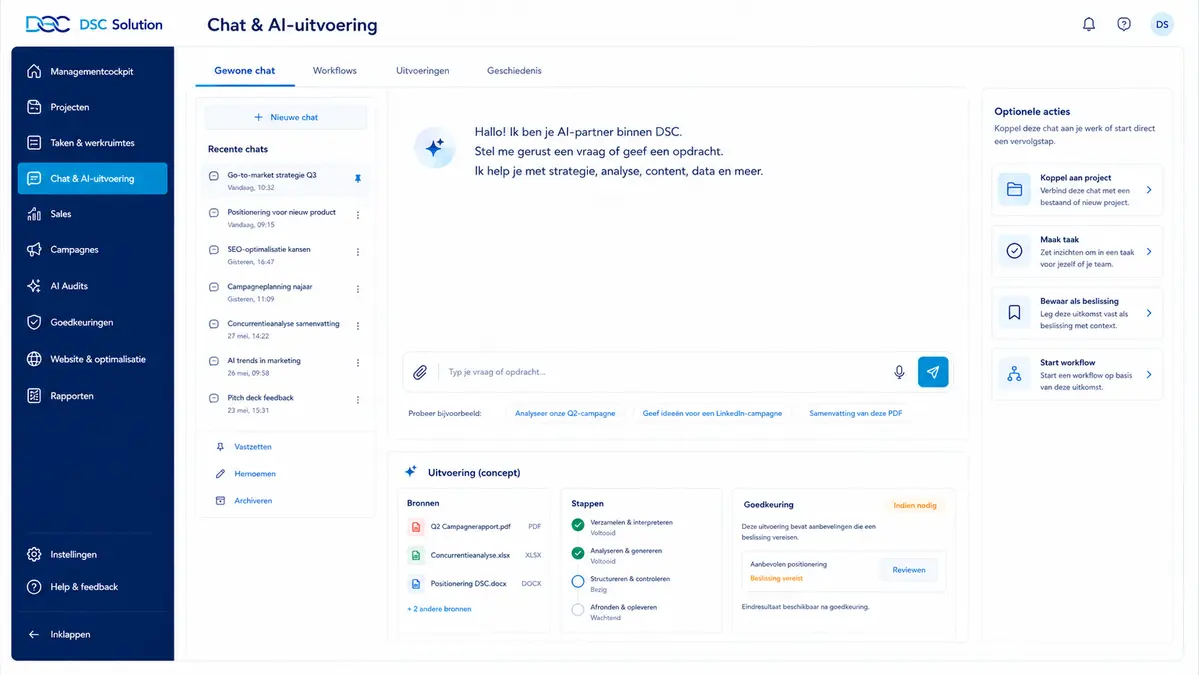
Marketing Automation & CRM is the first business module. By organisation we confirm availability, links, user roles and defined execution.
The website shows approved concept screens and a video. Discuss with DSC what operation within your scope is demonstrably available.
Discuss a management pilotDSC works with SMEs that want to get more value from their existing software, data and processes. Our approach is especially relevant when information is spread across several systems, teams spend substantial time on repetitive or administrative work, or management wants a clearer overview and faster execution without adding more disconnected tools.
DSC works across business areas. Its current live focus is Marketing & CRM, AI and agents, and management oversight. The architecture is also designed to support areas such as operations, finance, projects and service once the required modules and connectors are available.
Yes. Where a suitable Portal module is available, you can start directly with a defined operational use case. For areas that are not yet supported, or for broader strategic questions, an AI Audit may be the right first step.
Your team remains responsible for objectives, decisions and boundaries. AI can analyse information, make recommendations and carry out permitted tasks, while roles, permissions and approvals determine what it may do independently and where human intervention remains necessary.
We discuss your objectives, current systems, key processes, challenges and desired outcomes. Together, we then identify the most sensible next step: a focused Audit, a limited use case, a direct start with the Management Portal or another phased approach.
Isolated AI tools usually serve one user or application at a time. DSC connects systems, data and processes to a central AI layer with shared context, roles, permissions, workflows and approvals. AI can then do more than answer questions: it can prepare proposals, carry out tasks and monitor results within your governance framework.
Yes, where technically feasible and appropriate. The aim is not to replace software that already works well, but to connect systems to the central AI layer through connectors and APIs. We validate the possible integrations for each environment.
The DSC AI Management Portal is an AI-powered management layer above your existing systems. It brings together available business context so AI can analyse, advise, prepare proposals, carry out permitted tasks and track progress, within the permissions and approvals set by your organisation.
No. The starting point is to let existing systems continue doing what they do well. DSC connects your software to AI through secure connectors and APIs. Replacement is considered separately only when there is a demonstrably better fit.
Many solutions add AI separately to each software package. DSC takes the opposite approach: where possible, ERP, Marketing Automation & CRM, email, documents and other systems are connected to one central AI layer. This creates more shared context instead of leaving intelligence isolated in separate tools.
Yes. Within the permissions granted to it, the Portal can prepare work, carry out tasks, start workflows and monitor their progress. Human approval can be required for sensitive or important actions. The aim is not only better insight, but also less manual work and more effective execution.
Through roles, permissions, approvals, logging and clear boundaries. Your organisation decides which data and systems are available, which actions may run independently and which require prior approval. Greater autonomy does not have to mean less control.
The Portal is designed to analyse available business context on an ongoing basis, identify opportunities for improvement and suggest optimisations. This makes optimisation an ongoing process. It complements the formal DSC AI Audit, which provides an in-depth, guided analysis and an explicit roadmap.
Marketing & CRM V1 is the first business module available at launch. The broader architecture can later extend to other business areas once the relevant modules, connectors and use cases have been validated.
No. A chatbot is primarily a conversational interface. The DSC AI Management Portal combines context from connected systems with workflows, permissions, approvals and task execution. AI can therefore answer questions and contribute directly to real business processes.
No. The portal is designed as an AI-supported management and execution layer that can bring together information, decisions and follow-up around existing systems. It does not automatically replace a full ERP or CRM.
Often, but not automatically. We assess each platform and use case against its edition and licence, available APIs, access rights, data quality, security and the agreed scope.
Targeted custom development may be considered with the client’s express permission, if the platform, licence and technical access allow it. It is tested, documented and validated in each client environment. Platform names are examples, not a general compatibility guarantee or a claim of partnership.
No. AI can support analysis, preparation and defined execution. Authorised staff retain decision-making authority. Sensitive actions may require approval, and relevant steps are logged and made traceable where needed.
Marketing Automation & CRM is the first module. The concrete availability, integrations and user roles are confirmed for your scope; the website images are illustrative concepts.
Start with one manageable management cycle or use case. We first decide which information, decisions and follow-up genuinely need to be connected, then expand only when the operation, security and value have been sufficiently demonstrated.
Your goals, existing systems and team are the starting point. Together we determine a feasible next step.