Roles & Rights
Only access to what is necessary for the task.
You set the rules. AI works within them. Clear mandates allow controlled execution, with an owner and a review point where needed.
Rights and borders are part of every task.
Only access to what is necessary for the task.
The competent person shall assess sensitive actions.
Make proposals, decisions and implementation traceable.
Prefix exceptions, stops and recovery options.
Unclear access, loose actions and decisions without ownership make it difficult to take responsibility.
The team knows what AI can prepare, what actions are allowed and when a person decides. You can focus on giving more autonomy where that is justified.
Privacy, data separation and security are examined per application. This is not a general legal or security guarantee.
Define purpose, dates and rights.
Context and impact visible.
By a competent owner where required.
Within the approved limits.
Logging, exceptions and recovery.
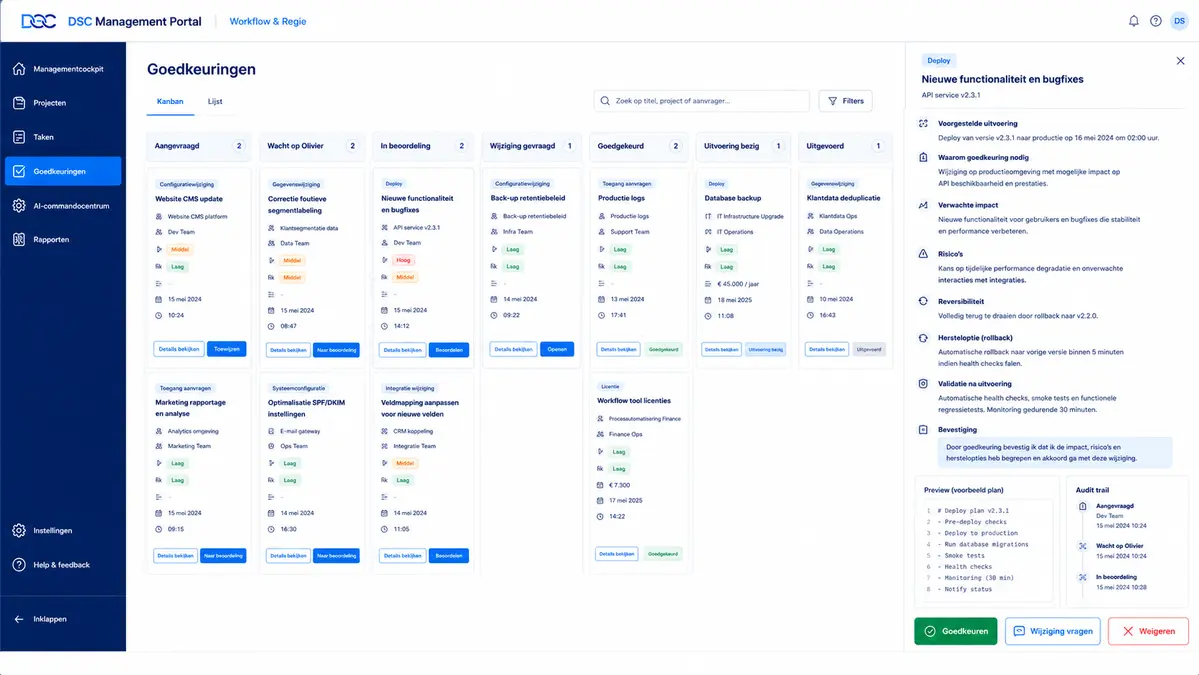
 AI Management PortalInteractive demo
Which actions are automatically allowed today?
This example mandate allows reading and preparing. An external change requires separate approval.
Allowed within the reading mandate.
Allowed without external changes.
Blocked until the competent owner approves the proposal.
May I prepare this proposal? First, look at the steps and boundaries.
Status: proposal ready
Example interaction · no live business data or external execution.For each task, we assess risk, impact, reversibility, sensitivity, permissions and the need for oversight. Only actions within an explicitly authorised mandate may be carried out autonomously.
The customer decides this for each process. Significant, sensitive, external or hard-to-reverse actions can require approval by default.
No. Roles and permissions determine which information, modules and actions each user may view or use.
Where the architecture supports it, relevant actions, approvals, errors and results are logged for traceability and follow-up.
Where technically feasible, we design actions to be reversible or provide a compensating step. Not every external action can be fully undone, so prior approval is sometimes necessary.
The system must make errors visible and prevent uncontrolled error propagation in critical processes. The appropriate response depends on the use case and severity.
Through appropriate authentication, connector permissions, least-privilege principles and logging. Secrets and tokens must not appear in ordinary user content.
Yes. That is a core principle of the tenant and governance architecture.
Personal data is minimised and processed only for clear purposes. For each implementation, privacy roles, legal basis, retention periods and processor agreements are legally validated where necessary.
Yes. Once the approach has proved itself, the mandate can be expanded in a controlled way, with the same rules for permissions, risk, logging and human approval.
Your goals, existing systems and team are the starting point. Together we determine a feasible next step.