
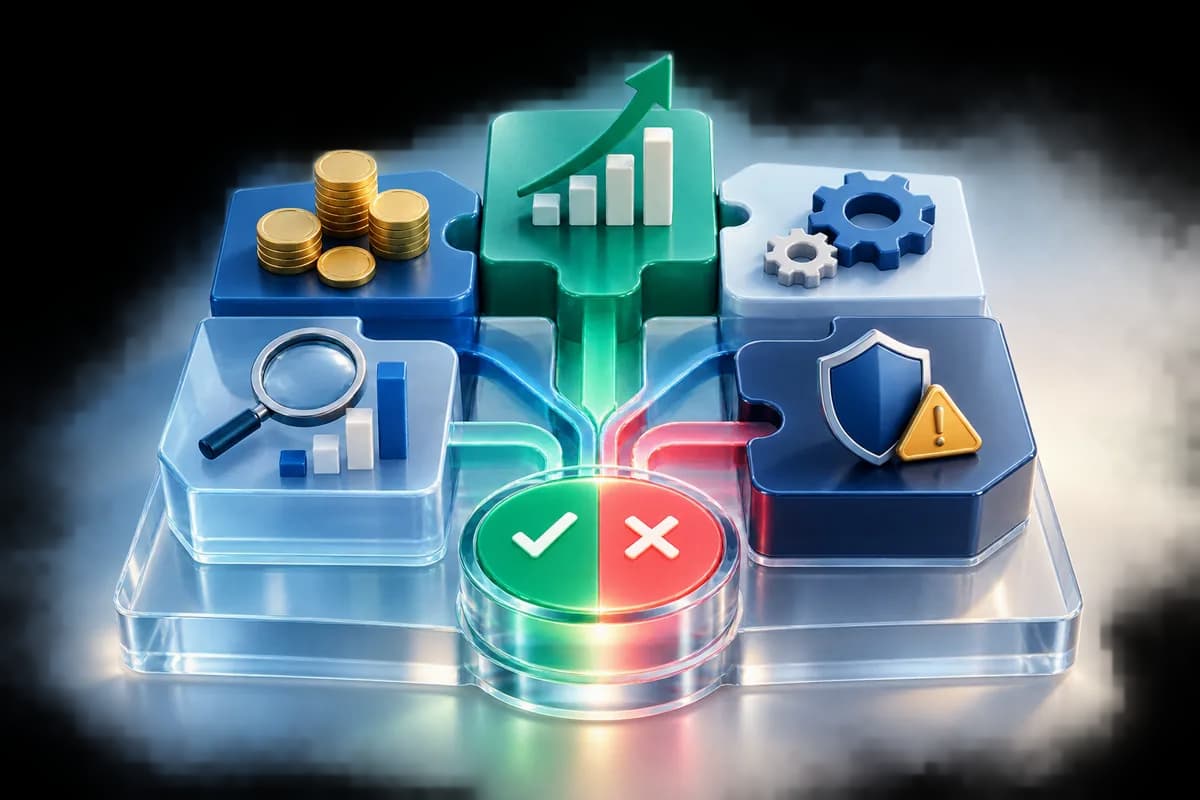
Strategic case
Why is change necessary and what needs to improve?
Economic case
Which options provide the best value-to-risk ratio?
Commercial case
Which supplier, contract and sourcing choices are appropriate?
Financial case
Is the investment affordable over its entire lifespan?
Implementation case
Are governance, people, planning and measurement arranged?
Start with the decision you want to make
A business case is not a document to justify an already chosen tool. She must help decision makers choose between doing nothing, improving the process without AI, a limited trial or a broader implementation.
Therefore, first formulate the business problem, the desired outcome and the reference alternative. Without 'business as usual' you cannot assess what the change really adds.
Sources for this section: HM Treasury · HM Treasury
Build on a verifiable baseline measurement
Measure current volumes, lead time, error and repair work, quality, personnel deployment and relevant risks. Use a representative period and note exceptions. A snapshot during a peak or quiet month can provide the wrong starting point.
Then make visible which data has been confirmed, which still needs to be validated and which remains uncertain. This prevents assumptions from being unknowingly treated as facts later.
Include full costs and realizable benefits
In addition to license or model use, there are costs for process analysis, data, integrations, testing, security, legal assessment, training, change, monitoring and maintenance. Internal time is also a real commitment, even if there is no external invoice in return.
Saving time does not automatically mean financial savings. It only creates value when released capacity is used for work that would otherwise not happen, when external costs decrease or when avoidable growth becomes possible without additional recruitment. Quality improvement and risk reduction can also be important, but specify how you observe them.
Work with scenarios and decision moments
Create at least a cautious, basic and favorable scenario. Only vary assumptions that materially influence the decision, such as adoption, actual achievable time savings, degree of exception, management burden and implementation duration.
Determine in advance which outcomes during the trial will lead to continuation, adjustment or termination. This way, a pilot does not become open-ended and you can invest in steps in which uncertainty gradually decreases.
Sources for this section: HM Treasury · NIST
Illustrative example: an AI assistant for document analysis
A fictional team investigates an assistant who prepares documents for review. The assumptions are that employees handle similar documents and that the final decision remains with an authorized employee.
The business case compares doing nothing, a template and search enhancement, and an AI assistant. The baseline measurement includes treatment time, rework and lead time. The test measures accuracy, acceptance, exceptions and actual time savings. Only when the basic variant meets the predetermined criteria will integration be considered.
When should you not invest yet?
Postpone the investment if the problem owner is missing, the baseline measurement is not reproducible, benefits only if theoretical time savings exist or necessary management and adoption costs remain out of the picture.
Start with a short business case at decision level: problem, baseline measurement, options, critical assumptions, full costs, measurement plan and next decision point. The level of detail should be proportionate to scale, complexity and risk.
Frequently asked questions
How do you start a baseline measurement?
Choose a representative period and measure volume, time, quality, rework, costs and relevant risks. Record definitions and exceptions so that the measurement is repeatable.
Which costs are often forgotten?
Internal process time, data work, integration, testing, security, training, change, monitoring, maintenance and exit or supplier costs.
How do you determine realizable benefits?
Make explicit which capacity can actually be redistributed, which costs demonstrably decrease and which quality or risks measurably improve.
How do you work out decision moments?
Link each phase to acceptance criteria, a decision maker and three possible outcomes: continue, adapt or stop.
Sources
The sources below support the indicated factual and regulatory passages. The practical decision frameworks are professional recommendations from DSC Solution.
- HM Treasury — Guidance on developing business casesNovember 17, 2022, updated October 10, 2023Gebruikt voor: a coherent strategic, economic, commercial, financial and implementation case.
- HM Treasury — The Green Book (2026)February 5, 2026Gebruikt voor: comparing options, making uncertainty explicit, proportionality and evaluation.
- NIST — Artificial Intelligence Risk Management Framework (AI RMF 1.0)January 26, 2023Gebruikt voor: risk management, governance and the cyclical measurement and management of AI risks.
- European Union — Regulation (EU) 2024/1689 — AI ActJune 13, 2024Gebruikt voor: risk-based obligations, documentation, monitoring and AI literacy.