AI assistant
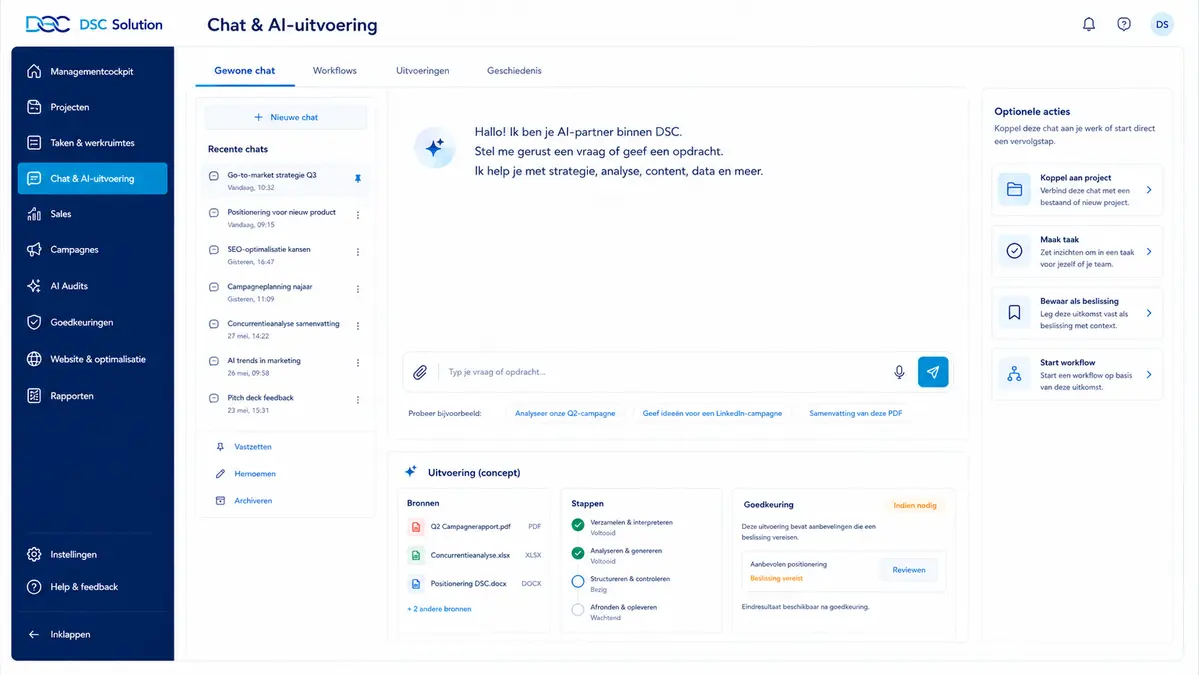
Supports employees with search, summary, preparation and control. The right autonomy is determined by usecase.
DSC automates repetitive steps, connects systems and builds practical AI assistants, with clear boundaries, human oversight and measurable process goals.
Understand, decide, execute, follow-up, under your control.
Watch the Portal demo AI Management PortalInteractive demo
Which actions are automatically allowed today?
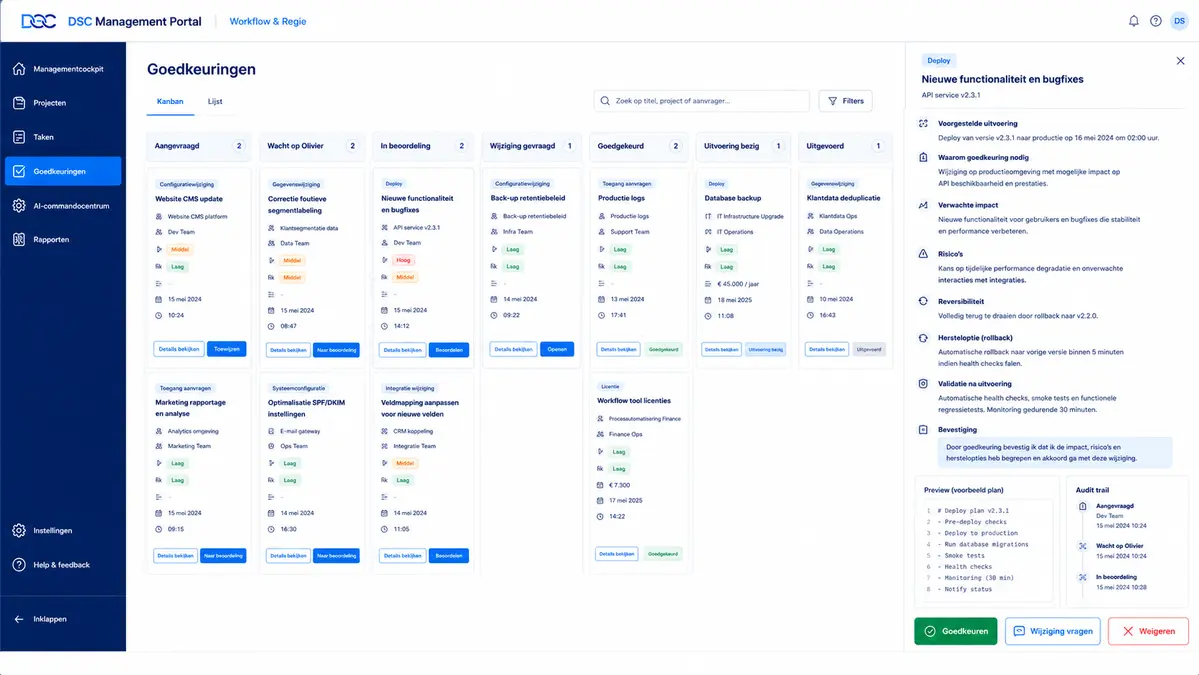
This example mandate allows reading and preparing. An external change requires separate approval.
Allowed within the reading mandate.
Allowed without external changes.
Blocked until the competent owner approves the proposal.
May I prepare this proposal? First, look at the steps and boundaries.
Status: proposal ready
Example interaction · no live business data or external execution.Not every task needs to be automated. We are looking for processes with sufficient volume, repetition and predictability, where time savings, capacity, quality or speed can be shown to improve.
ERP, CRM, digital channels, data and people directly connected.
With human control at the right time.
Supports employees with search, summary, preparation and control. The right autonomy is determined by usecase.
Executes defined steps within predefined lines. Automatically where it can, checked where it should be.
Adding valid pre-and-after preview.
AI agents are software-based assistants that can analyse, prepare, carry out and monitor tasks within predefined rules. They use available business context and connected systems to take steps within the permissions, boundaries and approvals set by your organisation.
That depends on your processes and connected systems. Examples include handling emails, following up leads, updating CRM data, preparing meetings, analysing documents, generating reports, gathering information and coordinating workflows. We automate only tasks for which access and governance are in place.
No. We aim to keep existing software where it works well. Connectors can link ERP, Marketing Automation & CRM, email, documents and other systems to the central AI layer.
Each agent operates within explicit permissions. Your organisation decides which data and systems it may access, which actions it may take independently and which require prior human approval. Important actions can be logged and reviewed.
Yes, for tasks authorised in advance. Routine, low-risk actions may be automated. Approval steps can be required for sensitive, significant or hard-to-reverse actions.
AI can make mistakes. DSC therefore combines automation with permissions, approvals, logging and human review where needed. For critical processes, we deliberately limit autonomy and provide fallback or recovery mechanisms where appropriate.
That depends on process complexity, data, connectors and the desired level of autonomy. A clearly defined use case may start relatively quickly; more complex workflows require more analysis, integration and testing. DSC therefore works in phases.
Yes. That is often a sensible approach. We can start with one process or repetitive task, evaluate how it works and then expand in a controlled way.
No. The tools shown are examples. Which systems can be connected depends on available APIs, connectors, technical feasibility and access rights.
We define in advance which outcome the agent should improve: for example, less manual work, faster processing, better follow-up, fewer errors or more time for higher-value work. The relevant KPIs vary by use case and are set beforehand where possible.
Yes. An organisation does not need a large IT team to start with a limited AI agent use case. The solution is tailored to its size, processes, risks and maturity.
Traditional automation usually follows predefined rules. An AI agent can also interpret information, use context, prepare decisions and combine steps within agreed boundaries. DSC uses both: automation where predictability matters, and AI where context and flexibility add value.
The aim is not simply to replace people, but to take on routine, time-consuming work so employees have more time for customers, decisions, creative work and other tasks where human expertise adds most value. Your organisation decides which tasks AI performs and where human involvement remains necessary.
Especially recurring processes with clear input, rules and outcomes, sufficient volume and measurable lead time.
Not necessarily. Value often comes from connecting existing systems more effectively or extending them in a targeted way. Custom work depends on the platform licence, technical access, available APIs, client permission and the chosen scope.
An assistant supports a user; an agent carries out independent steps within agreed limits.
With validation rules, logging, fallback procedures and human control for exceptions or risky decisions.
With one defined usecase, a zero measurement, clear acceptance criteria and a controlled pilot.
Preface one concrete process and determine which steps can be automated
and where human control remains necessary.