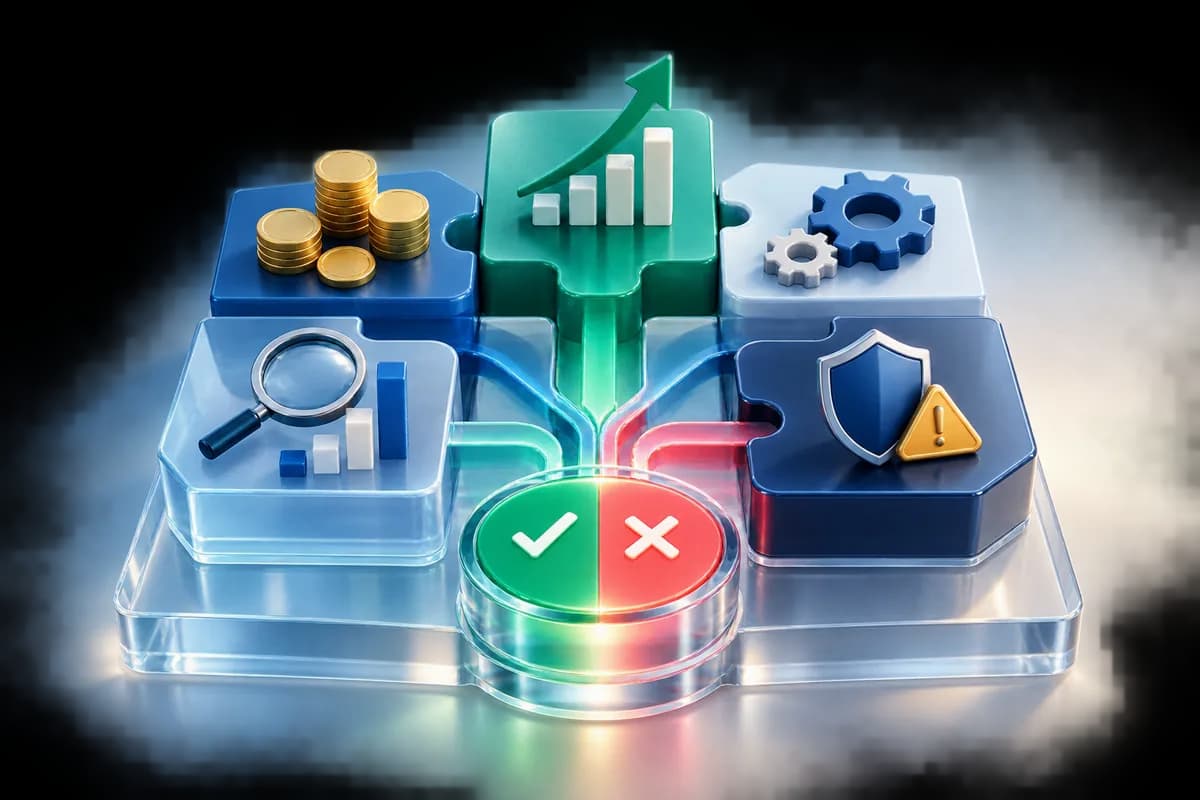

Define the goal
Define the problem and the desired outcome.
Group opportunities
Group ideas around processes and value streams.
Assess three dimensions
Assess value, feasibility and control.
Plan dependencies
Put data, process decisions and integrations in the right order.
Decide in stages
Use pilots, validation criteria and explicit go or no-go decisions.
Why a list of ideas is not yet an AI roadmap
Workshops often produce dozens of ideas: summarising documents, preparing quotations, classifying customer enquiries or supporting planning. That is useful input, but it is not an implementation plan. Ideas differ in expected value, data needs, process maturity, risk and technical dependencies.
Without a decision framework, the most visible or technically appealing ideas can easily come first. An organisation may then start several experiments before ownership, data quality or integrations have been addressed. A roadmap makes those dependencies clear and prevents a pilot from being mistaken for an operational system.
A practical decision framework: value, feasibility and control
Business value goes beyond potential time savings. Ask which outcome will improve, who will benefit and how you will measure the change. Examples include shorter lead times, less rework, higher quality, more capacity or better controlled risk.
Feasibility is about more than technology. Is the process stable enough? Are the required data available and usable? Can existing systems be connected safely? Do the employees who know the process have time to take part? Control also covers privacy, security, explainability, exceptions and the ability to intervene.
- Which specific business outcome needs to change?
- What baseline and data are available?
- Which process steps, systems and owners depend on each other?
- Which errors are acceptable, and which are not?
- Where is human oversight or formal approval required?
Prioritise what to learn first
The best first use case is not always the one with the highest theoretical return. A smaller initiative may be more valuable if it quickly provides evidence about data, adoption or integration while establishing a building block for later applications.
Work in phases. Exploration confirms the problem, scope and baseline. A defined trial tests the critical assumptions. Controlled implementation follows only then. Agree acceptance criteria, decision makers and stop conditions before each phase.
Illustrative example: document processing
Imagine a fictional B2B service provider that wants to extract information from incoming documents automatically. The assumption is that employees spend too much time retyping and checking details. Before planning the work, the team measures document volume, variation and where errors currently arise.
An initial trial uses one document type and has an employee confirm each extraction. A connection to the core system is considered only if completeness, error handling and processing time meet the agreed criteria. The trial therefore tests both the model and whether the process can be managed safely.
What does this mean for your organisation?
A roadmap helps when ideas are piling up, pilots are developing in isolation or teams are following different priorities. Start with a shared view of business goals, processes, opportunities, dependencies and owners.
Do not start building while the problem is unclear, the baseline is missing or essential data are not lawfully and reliably available. A realistic first step is a short prioritisation session to select a few promising use cases for further validation.
Sources for this section: European Union · Belgian Data Protection Authority
Map your AI opportunities systematically
The AI Opportunity Scan provides an initial framework for assessing value, feasibility and control.
Start the AI Opportunity ScanFrequently asked questions
How many use cases should a first roadmap include?
There is no fixed number. Limit the active portfolio to what your organisation can validate, support and manage at the same time. Keep a longer list as an idea backlog.
Does every use case need a financial return?
No. Quality, risk reduction, compliance and the employee or customer experience can also be valuable, provided the intended change and how to measure it are clear.
How often do you review the roadmap?
At least at each validation or decision point, and whenever an important assumption, dependency or legal context changes.
When is a pilot successful?
When the agreed assumptions have been tested enough to make the next decision. That decision may also be to stop development.
Sources
The sources below support the indicated factual and regulatory passages. The practical decision frameworks are professional recommendations from DSC Solution.
- NIST — Artificial Intelligence Risk Management Framework (AI RMF 1.0)26 January 2023Used for: risk management, governance, and the ongoing assessment and management of AI risks.
- NIST — AI RMF Playbookaccessed 29 August 2026Used for: practical actions for Govern, Map, Measure and Manage.
- European Union — Regulation (EU) 2024/1689 — AI Act13 June 2024Used for: risk-based obligations, documentation, oversight and AI literacy.
- Belgian Data Protection Authority — Information brochure on artificial intelligence systems and the GDPRDecember 2024Used for: Belgian considerations for AI and personal data.